
#StudyCase
evertrip
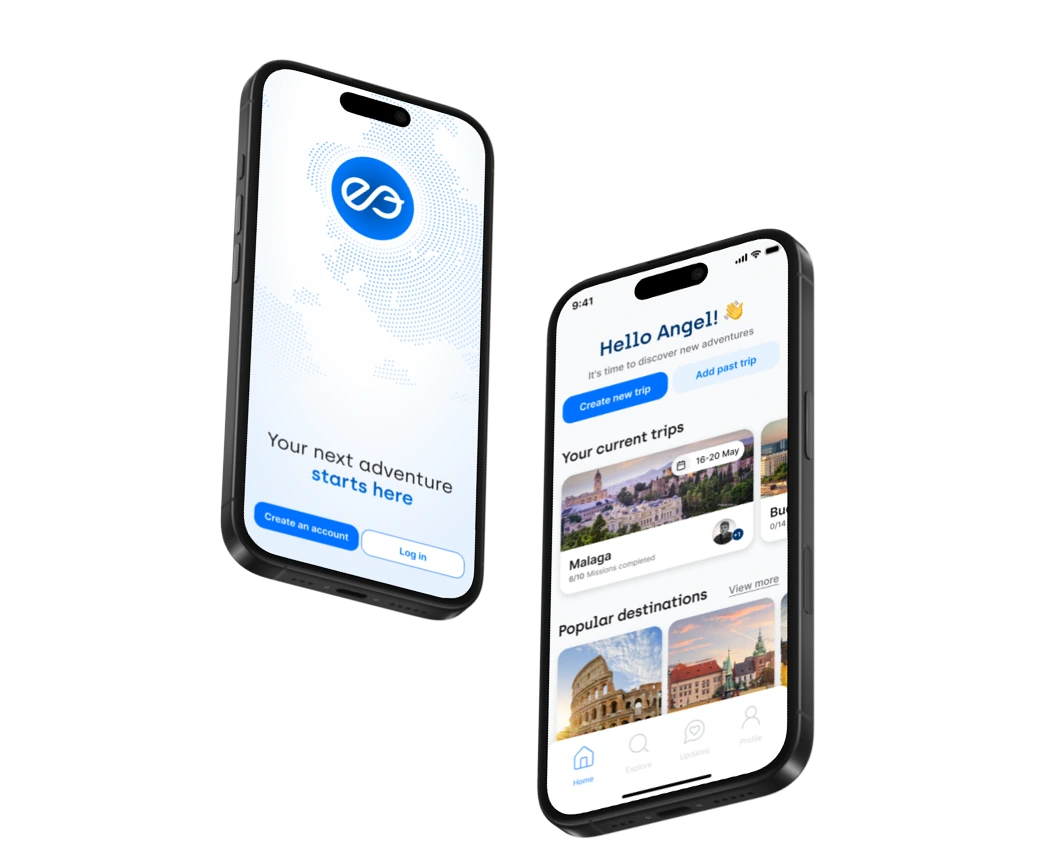
This project is an app in development that I designed end-to-end. I will show you how I simplified travel planning to increase plans completion using behavioral design.
| Sector | Travel · Lifestyle · Mobile |
| Challenge | Overload, disconnection, forgetfulness |
| Rol | Product Designer (End-to-End) |
| Duration | 5 month |
About the product
Evertrip is a gamified travel planner developed in React Native for iOS and Android. Our north star metric is Mission completion. We designed and tested the MVP in three months, it’s now in development.
The main challenge was Designing an experience to increase completion with limited resources.

Technology
Developers
Months
My Role
Product Designer – Strategy, UX/UI, and Behavioral Design
- End-to-end product design
- Built the design system
- Led Product decisions with two junior developers
Problem
Information overload prevents travelers from completing travel plans, resulting in low engagement and community stagnation.
Objetive
Current behavior
Jumping between multiple apps → Planning overload
Desired behavior
Exploring in our app → Completing missions easily
I defined our objetive in a question: How we reduce planning overload to increase plans completion?
Research Insights
To achive our objetive I did a research. I used primary research (6 interviews and 85 surveys) and complemented it with secondary research (Literature, reports…).
I used Google Forms and Fireflies for data collection, with Chat GPT assisting the analysis.
User persona
Our User Persons is Carlos a 28-year-old freelance programmer who valorate flexible planning.
Pains:
- Information overload
- Difficulty finding plans
- Limited time
Motivations
Quick and easy planning
Remembering trips
Getting inspiration from others

User Contexts
I analized the main user contexts for this case:
Temporal
The duration of the activities is important for organising them
Environmental
Proximity matters; central locations explored first
Social
Trip type (couple, family, friends, solo) shapes interests
Emotional
Complete a travel plan makes travellers feel accomplished
Economic
Need transparency about costs
Capacity
User need clear guidance to reduce uncertainty
Benchmarking
I decided to do a benchmarking to learn from competitors to make our product better:
| Competitor | Take advantage of | Avoid |
|---|---|---|
| Airbnb | Clean interface | No social or collaborative planning |
| Polarsteps | Trip tracking | Low personalization |
| TripAdvisor | Large database of activities | Information overload |
Behavioral Frameworks
Now let’s look at the solution and how we used behavioral frameworks to design the mission flow. I used two main frameworks to create an habit:
TO STAR & COMPLETE
Fogg Model
Supports micro-behaviours like start and complete mission
- Motivation aligned
- Ability simplified
- Clear Prompt at the right moment
TO REPEAT
Hook Model
Creates a habit loop during the trip
- Trigger to start
- Simple action
- Small reward
- Habit reinforcement
Design decisions
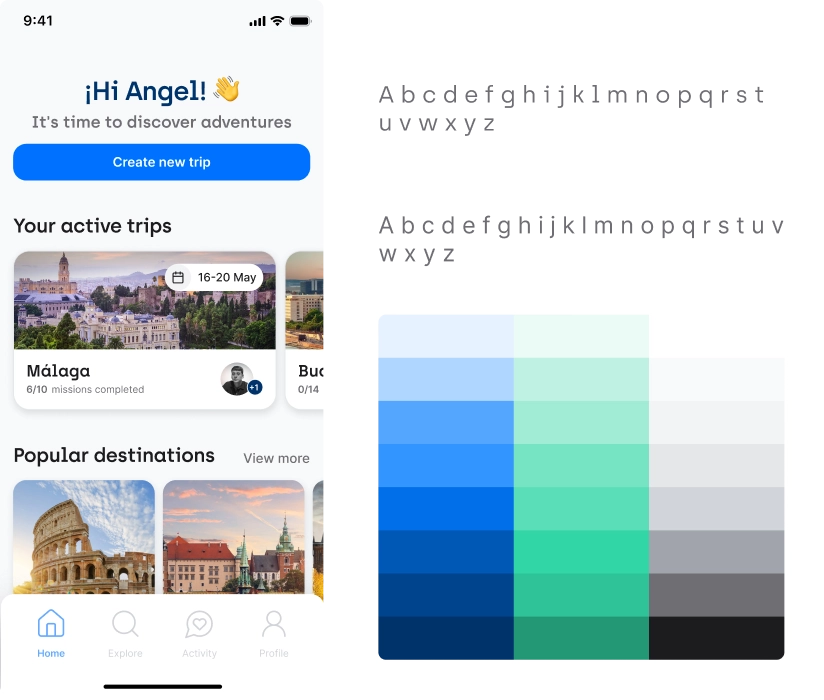
The design system is founded on a modern, minimalist style, consistently prioritizing accessibility and optimal usability within dynamic travel environments.
Mapping
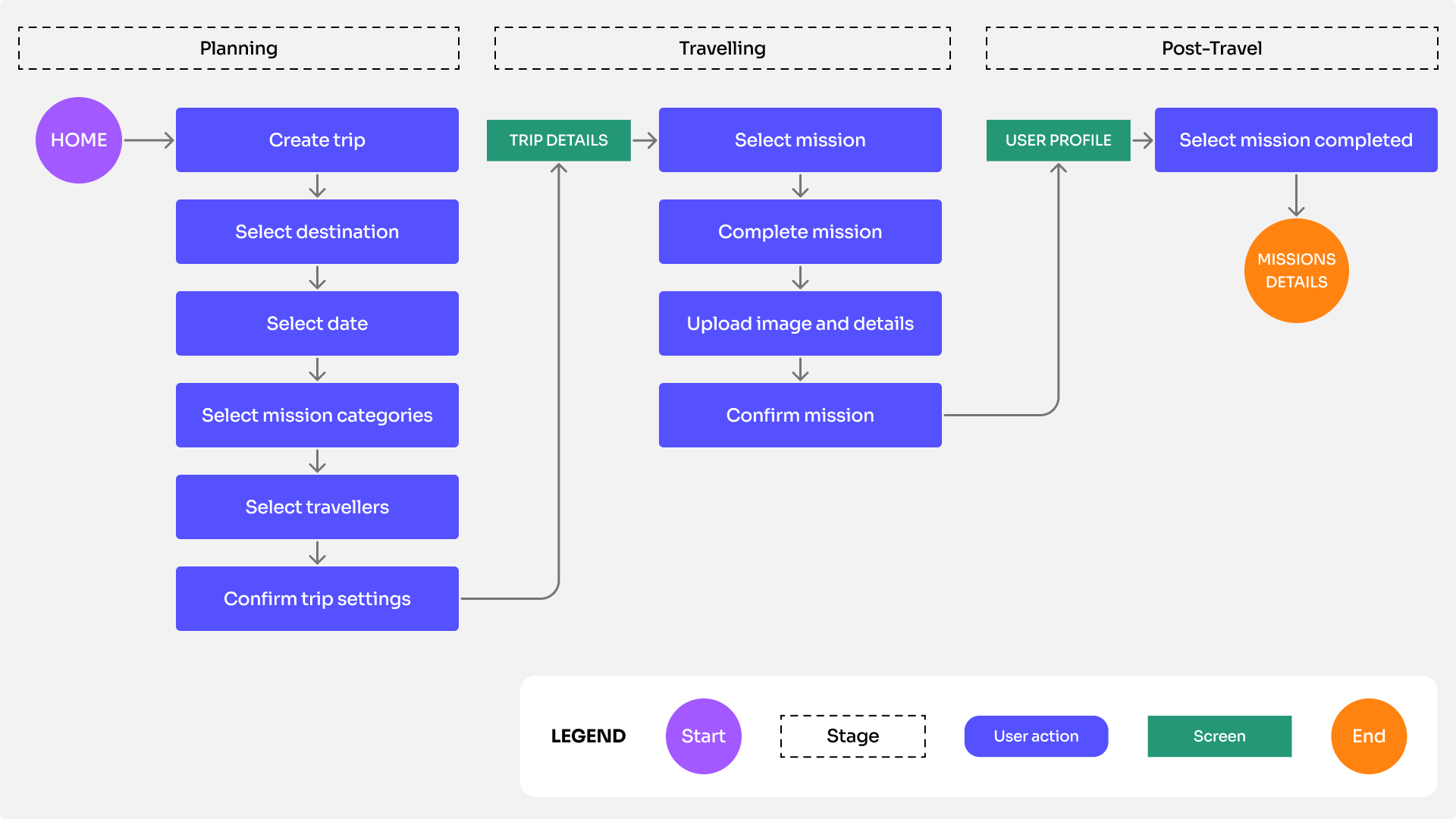
Mapping the planification process, we identified three key points across different screens:
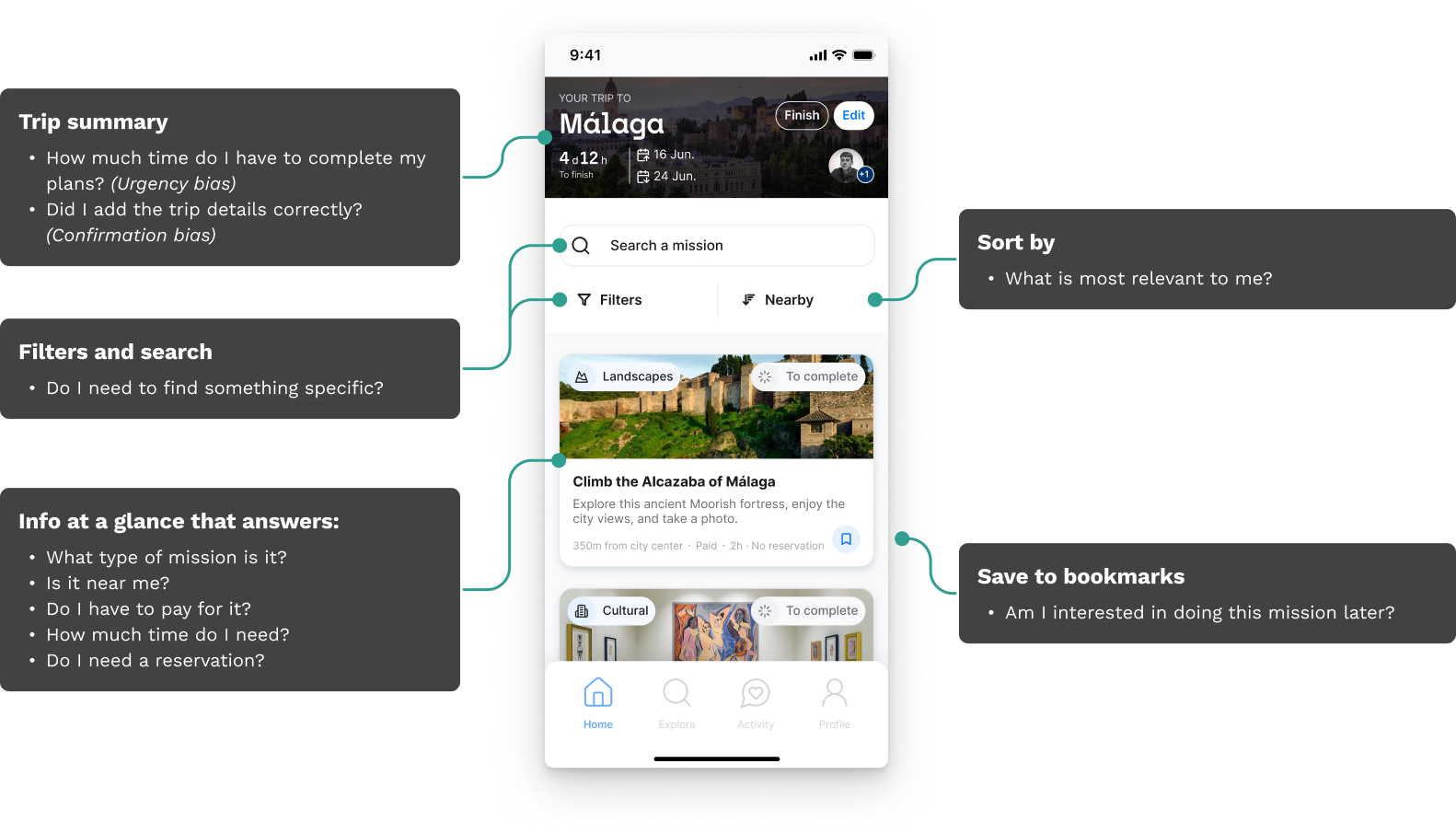
Explore mission
Screen: Trip details
Objective: Users find missions that fits their needs easily
During the Exploration stage, the design focuses on quickly answering users’ key questions by providing a clear trip options
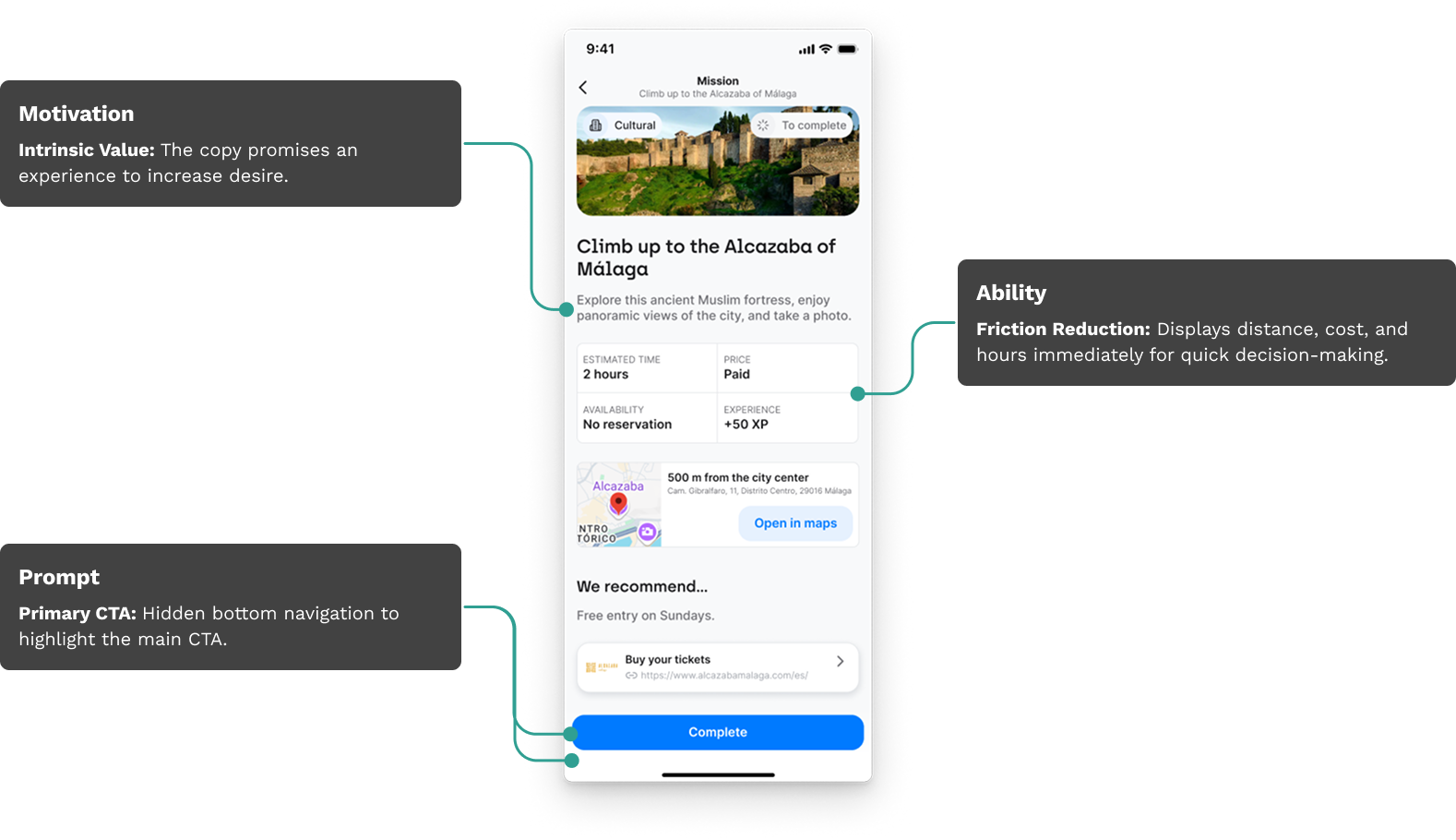
Select mission
Screen: Mission details
Objective: Users check that mission fits their needs quickly
I based the design on the Fogg Behavior Model to guide the user toward completing a specific action.
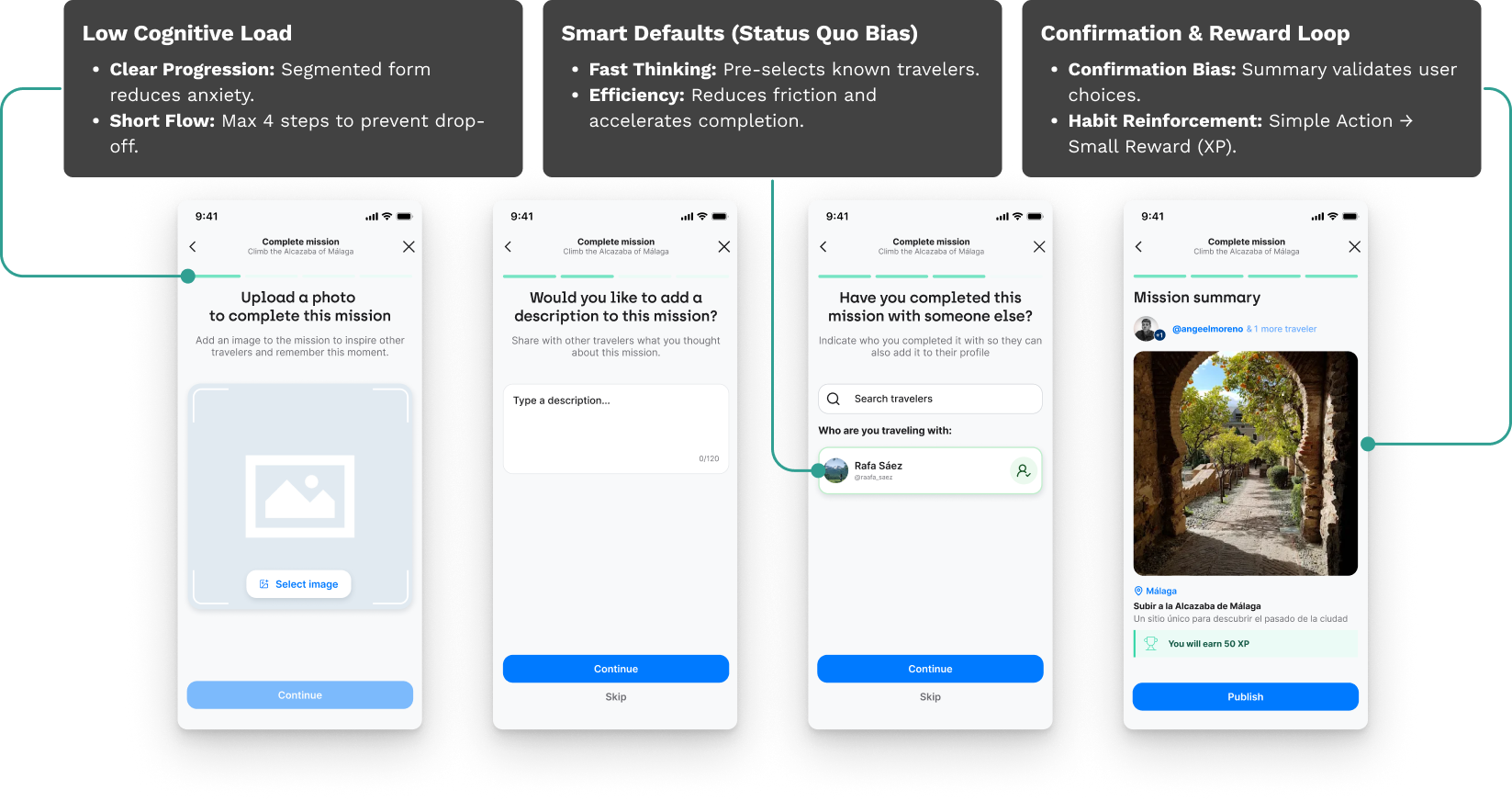
Complete mission
Screen: Complete flow
Objective: Users complete the mission successfully
At this point, the main focus is on supporting quick, confident decisions with low cognitive load.
Impact
Test septup: Prototype tested via Screen-Sharing Videocalls by 10 users
Test result: SUCCESS
The ‘Mission’ concept is engaging.
%