
#StudyCase
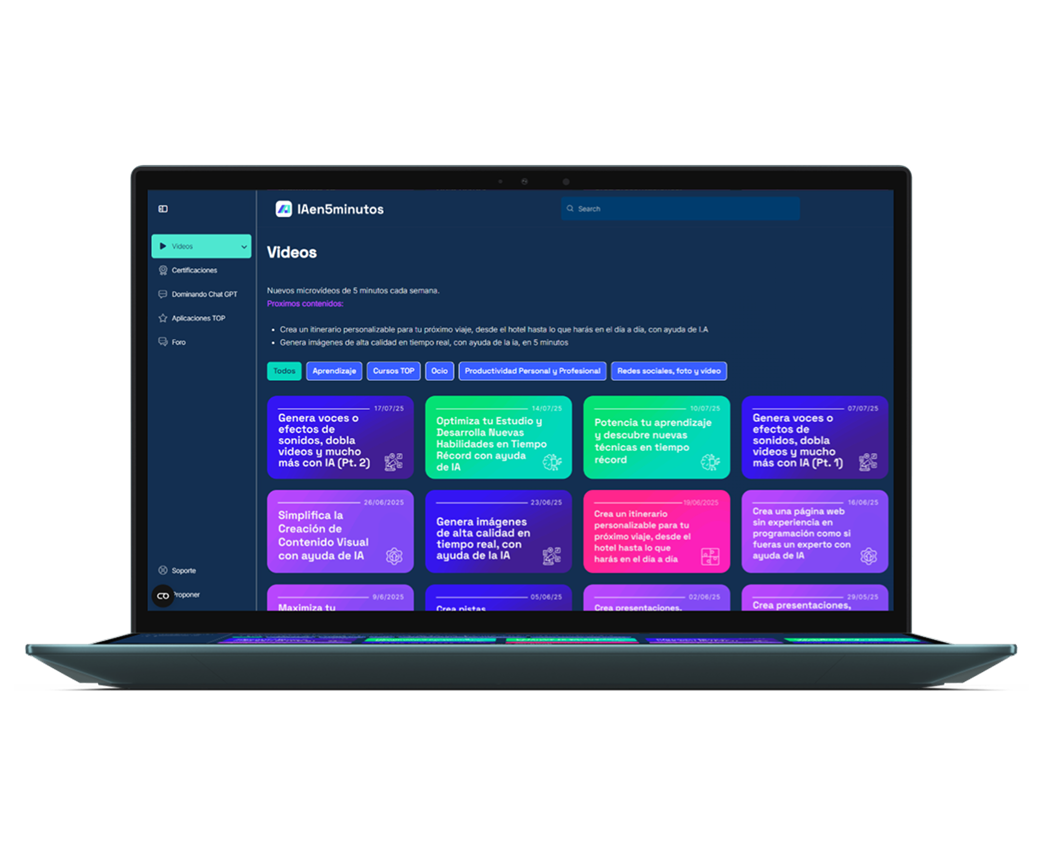
IA en 5 minutos: Onboarding
In IA en 5 minutos, a AI educational membership, users struggled to complete certifications due to low awareness, unclear benefits, and difficulty choosing among 12 options. I designed a personalized onboarding and visual tutorial that recommended the right certification, highlighted its value, and simplified access to the exam, reducing friction and boosting motivation.
| Sector | Online Education / SaaS |
| Challenge | Increase certification completion |
| Rol | Product Designer |
| Duration | 3 weeks |
Increasing Certification Completion in an AI Platform through Personalized Onboarding
Due to technical complications beyond my control, I was not able to obtain quantitative data for this project. For that reason, the impact is described using qualitative and process-based improvements observed during the design and validation phases.
The platform offered 12 AI certifications (ranging from image editing to automation and 3D design). Despite strong initial interest, many users dropped out in the early stages.
The main issue was not a lack of content but rather a lack of clarity and motivation at the beginning of the journey, which led to uncertainty about which certification to choose and how to proceed.
1. My Role
- Ideation, visual design, and structuring of the onboarding and tutorial flow.
- Collaboration with the development team to ensure technical feasibility (popup, form, sticky CTA).
- Collaboration with the analytics team to define qualitative success indicators and validate hypotheses on certification completion.
- Applied UX, UI, and behavioral design principles to motivate users to take the first step and complete more certifications.
2. Problem Identified
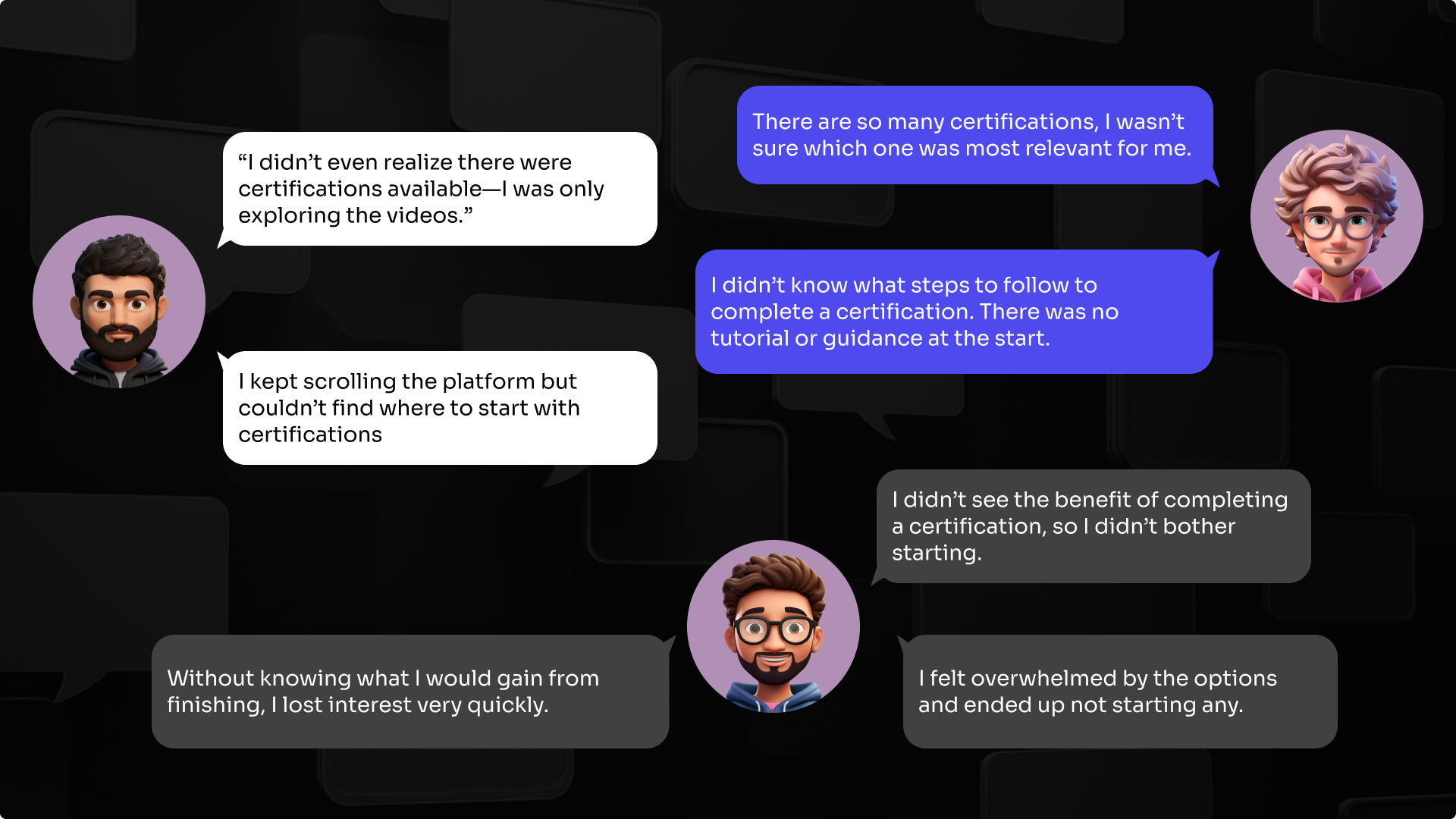
After conducting interviews with 4 users, I discovered the following barriers:
- Lack of visibility: Users didn’t find certifications on the platform.
- Difficulty choosing: Users didn’t know where to start among so many certifications.
- No initial guidance: There was no flow explaining benefits or steps to follow.
- Low motivation: Without seeing the final value, many abandoned before getting started.
3. Solution
I applied the EAST framework (Easy, Attractive, Social, Timely). This behavioral design framework helps identify simple and effective ways to influence user behavior, ensuring that actions—like starting and completing a certification—are easy, motivating, socially reinforced, and timely. By analyzing the user journey through this lens, I was able to design a solution that guides, motivates, and empowers users to take action.
E – Easy
Reduced friction with a step-by-step onboarding that guides users through 12 certifications.
A 3-question form simplifies the decision-making process and recommends the most relevant certification.
A persistent sticky button allows users to access the exam at any point, minimizing extra steps.
A – Attractive
Visually engaging slide-based tutorial with clear progression and card-based recommendations.
Benefits of certification (diploma, professional recognition) are highlighted from the first popup to motivate users.
Micro-interactions in the tutorial provide immediate feedback, reinforcing a sense of progress.
S – Social
Diplomas provide social recognition, which can be shared or displayed as an achievement, motivating users through social proof.
Microcopy that reinforces that companies are looking for AI specialists.
T – Timely
Onboarding is presented immediately when users enter the platform, providing guidance when it’s needed most.
Certification recommendations are delivered right after the 3-question form, encouraging immediate action.
The tutorial appears just before the exam, reinforcing benefits and instructions at the critical moment of decision-making.
4. Results
Although no quantitative metrics were measured, qualitative and process improvements were observed:
Stronger initial orientation: users better understood the flow thanks to the tutorial.
Reduced friction: the form simplified decision-making, lowering choice overload.
Higher motivation: by showing benefits and a clear CTA, users were more willing to start the exam.
Strategic alignment: The solution allowed more users to discover the certifications, find the most suitable one for them, and understand the value of earning a diploma. Early qualitative feedback showed an increase in motivation and interest in completing the exams.
5. Conclusion and Learnings
The personalized onboarding and visual tutorial helped reduce friction and increase user engagement with the certifications.
I learned that small interventions in the user experience, combined with behavioral design, can turn motivation into action and deliver significant value for both the user and the business.